The Hidden Costs of a Cheap, Fast SaaS MVP
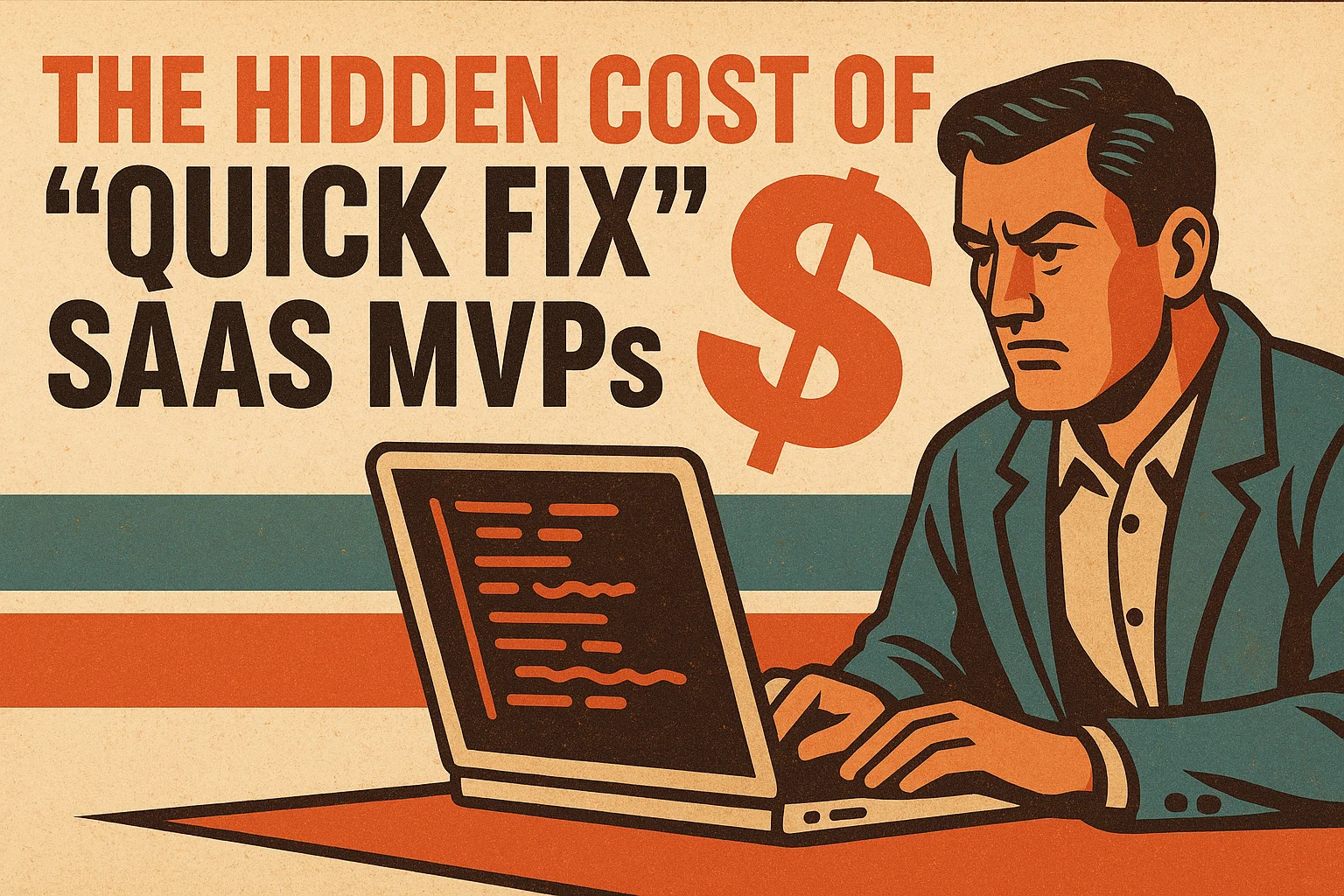
"Move fast and build an MVP" is good advice right up until "fast" quietly becomes "reckless." A bare-bones MVP gets you to market and tests your idea, which is exactly right. But cutting the wrong corners to save a little time and money now creates hidden costs that arrive later with interest. Here is what a too-cheap MVP actually costs you, and how to move fast without setting a trap for your future self.
The Real Price of That Speed
You save ten thousand dollars on development now. Congratulations. Here is what you actually bought along with those savings:
- Technical debt at a punishing interest rate: you will refactor it later, except you will not, so eventually you rebuild it from scratch, paying twice.
- Security holes big enough to drive a truck through: who needs authentication on an admin panel? Everyone does, as you will discover at the worst possible moment.
- A stack that will not scale: that quick app on cheap shared hosting is fine until real users show up, then it buckles.
- No migration system: one schema change and production goes down, because nothing manages your database changes safely.
- No deployment process: every release becomes a manual, error-prone ritual that nobody wants to perform.
None of these feel like problems on launch day. All of them become expensive problems precisely when things start going well, which is the cruelest possible timing.
"We'll Fix It Later" Means "Never"
Here is the developer translation of the most common MVP promise. "We'll fix it later" almost always means "never," not because anyone is lazy, but because once the product has users and momentum, there is never a convenient time to stop and pay down the debt. New features always feel more urgent than fixing foundations nobody can see.
So the shortcuts you took to ship fast harden into permanent fixtures. The temporary hack becomes the load-bearing wall. The "we'll add auth properly soon" becomes the security hole in production a year later. Treating MVP shortcuts as temporary is comforting and usually wrong, because the debt does not wait politely for a good moment to be repaid.
So How Do You Avoid MVP Regret?
The goal is not to over-build, which is its own expensive mistake. It is to be deliberate about which corners are safe to cut and which are not. Some things can genuinely wait: polish, advanced features, edge cases, scale optimizations for users you do not have yet. Cut those freely.
But some foundations should never be skipped even in an MVP, because retrofitting them is far more expensive than building them in. Basic security and authentication are not optional. A sane database structure with migrations saves you from disaster. A minimal deployment process keeps releases safe. A stack that can grow at least to your next milestone prevents an early forced rebuild. The skill is distinguishing the corners that are cheap to fix later from the ones that are ruinous to fix later, and protecting the second group.
Quick Checklist Before You Ship Your MVP
Before you launch, run through the essentials that are painful to add after the fact:
- Is there proper authentication and access control, including on admin areas?
- Does the database have a real structure and a migration system?
- Is there at least a basic, repeatable deployment process?
- Will the stack handle your next realistic growth milestone, not just today?
- Are backups in place so a mistake is recoverable?
- Is sensitive data handled securely, in transit and at rest?
None of these require gold-plating. They require a baseline of responsibility, so that moving fast does not mean building something you will have to tear down the moment it succeeds.
Why Founders Keep Falling Into This Trap
If the hidden costs of a too-cheap MVP are so predictable, why do smart founders keep hitting them? Because the incentives all point toward cutting corners in the moment. Investors want traction yesterday, the budget is tight, and the foundational work, security, database structure, deployment, is invisible. Nobody celebrates a well-structured migration system. Everybody celebrates a feature that demos well. So the foundations quietly lose every prioritization battle.
The other reason is optimism. Every founder believes they will go back and fix the shortcuts once things calm down. But things do not calm down, they speed up, and the window to pay down debt cheaply closes the moment you have real users. Recognizing this bias in advance is the best defense. Assume you will not get a quiet period to fix foundations later, and build the essential ones now, while it is still cheap and nobody is depending on them yet.
Lean Is Not the Same as Fragile
The confusion at the heart of most MVP regret is treating "lean" and "fragile" as the same thing. They are opposites. A lean MVP does less, it has fewer features, less polish, and a narrower scope, but what it does, it does on solid foundations. A fragile MVP looks similar from the outside but is built on shortcuts that crack under the first real load. One is a deliberate minimum; the other is an accident waiting to happen.
The distinction matters because the advice "build an MVP" gets misheard as "build it cheaply however you can." Real lean thinking is about ruthless focus on scope, not ruthless cutting of quality. You strip away everything non-essential so you can build the essential things properly. Get that backwards, keeping lots of features but cutting the foundations, and you have built the most expensive kind of MVP: one that succeeds just enough to expose how badly it was made.
SaaS MVPs Should Be Fast, but Not Reckless
The whole point of an MVP is speed, and that is genuinely worth protecting. But there is a difference between a lean MVP and a fragile one. A lean MVP cuts scope while keeping the foundations sound, so it can grow. A fragile one cuts the foundations to save a little time, so it collapses under its own success. The first is smart. The second is a debt you take out against your own future.
Move fast, cut scope ruthlessly, and ship before it is perfect, all good instincts. Just do not cut the foundations that turn a successful launch into a crisis. Build the lean version of the right thing, not the cheap version of a broken thing, and you get the speed of an MVP without the hidden costs that sink so many of them. If you want an MVP built fast but on solid foundations, that balance is exactly what good development delivers.