Why Your Startup Website Is Confusing Everyone (Including You)
You know your product inside out, so your website makes perfect sense to you. The problem is that your website is not for you, it is for strangers who have thirty seconds, no context, and a dozen other tabs open. If those strangers cannot instantly tell what you do, they leave. Most confusing startup websites are not confusing on purpose, they are confusing because the people who built them were too close to see it. Here is how that happens and how to fix it.
The Most Common Startup Website Mistakes (and Why They Keep Happening)
1. You're Building a Brand, Not a Website
Branding matters, but when your startup website forgets it is supposed to be useful, you have entered dangerous territory. A visitor does not care that your primary blue is Pantone-approved. They want to know what you do, immediately. If your homepage opens with an abstract metaphor like "We empower synergy for tomorrow," congratulations, you have officially said nothing. Brand should support clarity, not replace it.
2. You Hired a Dribbble Designer Without Real-World Experience
There is a difference between a designer who makes beautiful screens for a portfolio and one who has shipped real products that convert. The first produces a website that looks stunning in a case study and confuses actual users. The second understands that design serves a goal beyond aesthetics. Hiring purely on visual flair, without real-world product experience, is how you end up with a gorgeous site that does not work.
3. You Prioritized Looks Over Logic
A website can be beautiful and useless at the same time. When you optimize for how impressive it looks rather than how clearly it communicates and converts, you get style with no substance. Animations that delay content, clever layouts that hide the value proposition, and visual flourishes that distract from the next step all prioritize looks over logic. The result looks great and performs terribly, which is the worst combination of all.
What a Good Startup Website Actually Needs
Clear Value Proposition
Above everything else, a visitor must understand what you do and who it is for within seconds of landing. A clear value proposition, stated in plain language at the top of your homepage, is the single most important element. If people have to scroll, hunt, or decode to figure out your product, you have already lost most of them. Clarity beats cleverness every time.
Logical Navigation
Your navigation should match how visitors think, not how your company is organized internally. Clear labels, a sensible structure, and an obvious path to the action you want all reduce friction. When someone can find what they need without thinking, the site is working. When they have to study the menu, it is not.
Real Content
Placeholder text, vague claims, and recycled stock imagery all signal a site that was rushed and a company that may be too. Real content, specific, honest, and written for your actual audience, builds trust and explains your value in a way generic filler never can. The words on your site do as much conversion work as the design around them.
Responsive and Fast
A large share of your visitors arrive on mobile, and all of them are impatient. A site that breaks on a phone or takes too long to load loses people before they read a word, no matter how good the content is. Responsive design and fast loading are not optional extras, they are the baseline that lets everything else have a chance to work.
But What About Storytelling?
Storytelling has value, but it is the seasoning, not the meal. A good narrative can make your value proposition more memorable and your brand more relatable, once the visitor already understands what you do. The mistake is leading with story at the expense of clarity, opening with an evocative scene while the visitor still has no idea what your product is. Earn the right to tell a story by first answering the basic question: what is this and is it for me? Then storytelling deepens the connection instead of replacing the information.
Warning Signs You Need a Redesign
How do you know your site has crossed from imperfect into actively harmful? A few honest signals. Visitors cannot explain what you do after looking at your homepage. Your bounce rate is high and time-on-site is low. The mobile experience is visibly broken. People ask you basic questions your site should already answer. And conversions are weak despite real traffic arriving. If several of these ring true, the website is working against you, and a redesign focused on clarity will likely pay for itself quickly.
The Curse of Knowledge
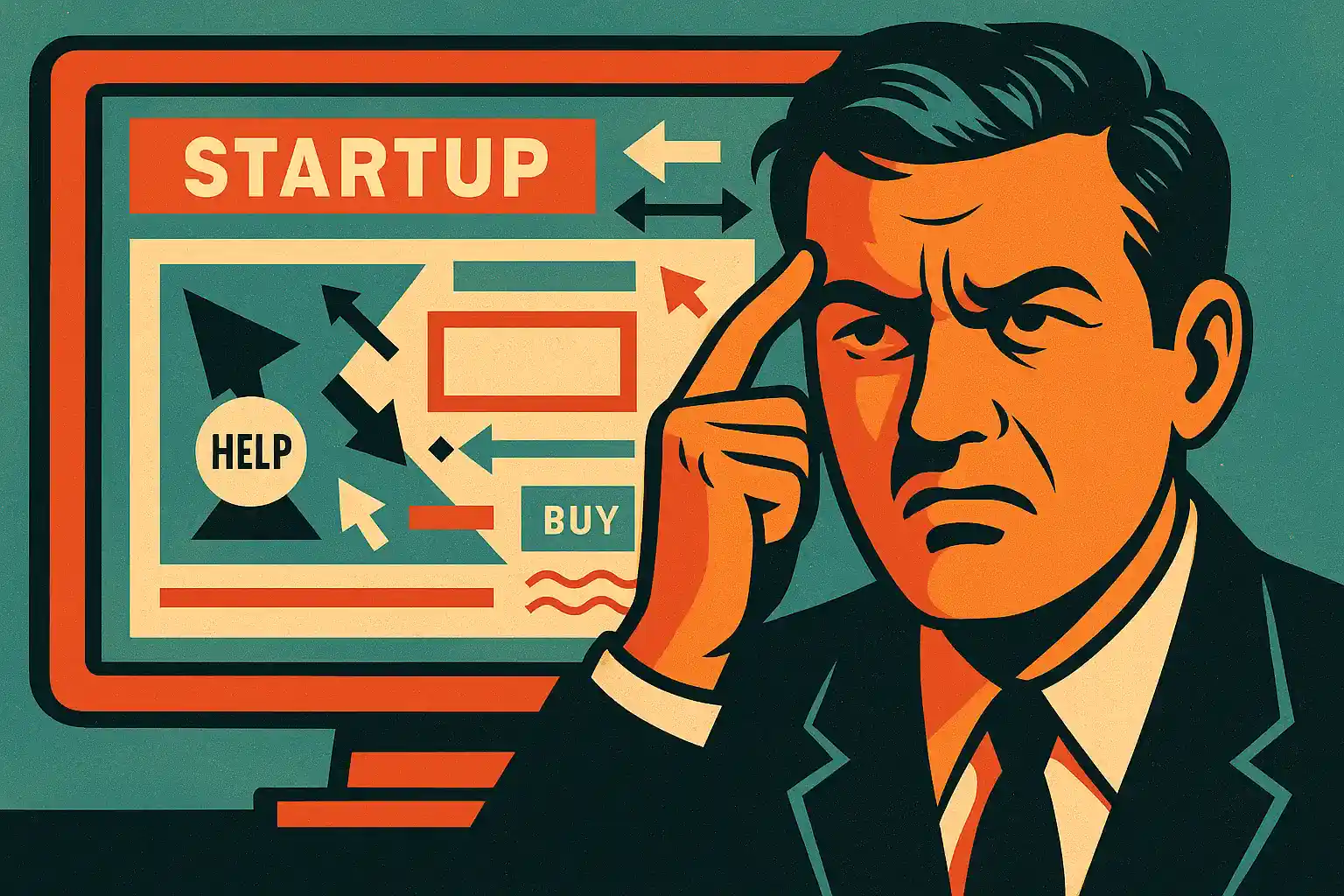
There is a name for why your website makes sense to you and confuses everyone else: the curse of knowledge. Once you deeply understand something, it becomes almost impossible to imagine not understanding it. You cannot un-know what your product does, so you cannot see how opaque your homepage is to someone encountering it cold. This is not a failure of intelligence, it is a universal cognitive blind spot, and it is exactly why so many startup websites confuse the very people they are meant to attract.
The only reliable cure is outside perspective. Show your site to people who know nothing about your product and watch where they get lost. Ask them to explain what you do after ten seconds. Their confusion, which feels obvious to them, reveals the gaps you literally cannot see yourself. This is also why user testing matters more than internal opinion: the team is cursed with knowledge, and only fresh eyes can tell you whether your clarity is real or imagined.
Final Words From Someone Who's Seen Things
The hard truth is that your startup website is probably clearer to you than to anyone else, because you carry all the context a visitor lacks. The cure is to ruthlessly step out of your own head and design for the confused stranger with thirty seconds and zero patience. Lead with a clear value proposition, build logical navigation, write real content, make it fast and responsive, and let storytelling support clarity rather than smother it. Do that, and your website stops confusing everyone, including you, and starts doing its actual job: turning strangers into customers. If you want help building a startup website that is clear instead of clever, that is exactly what our SaaS team does.