Why the Backend Is Your SaaS Secret Weapon
The frontend gets all the compliments. It is the charming face of your product, the part that whispers sweet nothings to users and looks great in a pitch deck. Meanwhile, the backend is in the basement doing the actual work: managing databases, handling user authentication, running server-side logic, juggling API integrations and cloud computing, and quietly making sure your app does not crash harder than your dreams of early retirement.
A strong SaaS backend is what separates a product that scales from a product that becomes a cautionary tweet. It quietly delivers:
- Performance, meaning fast, reliable responses instead of spinning loaders
- Security, protecting user data like a digital Fort Knox rather than a screen door
- Scalability, so growth becomes a good day instead of an outage
- Maintainability, so updates do not feel like defusing a bomb
The backend is not just a tech layer. It is your SaaS platform's spine, and nobody admires a spine until it goes.
The Must-Haves for a Rock-Solid SaaS Backend
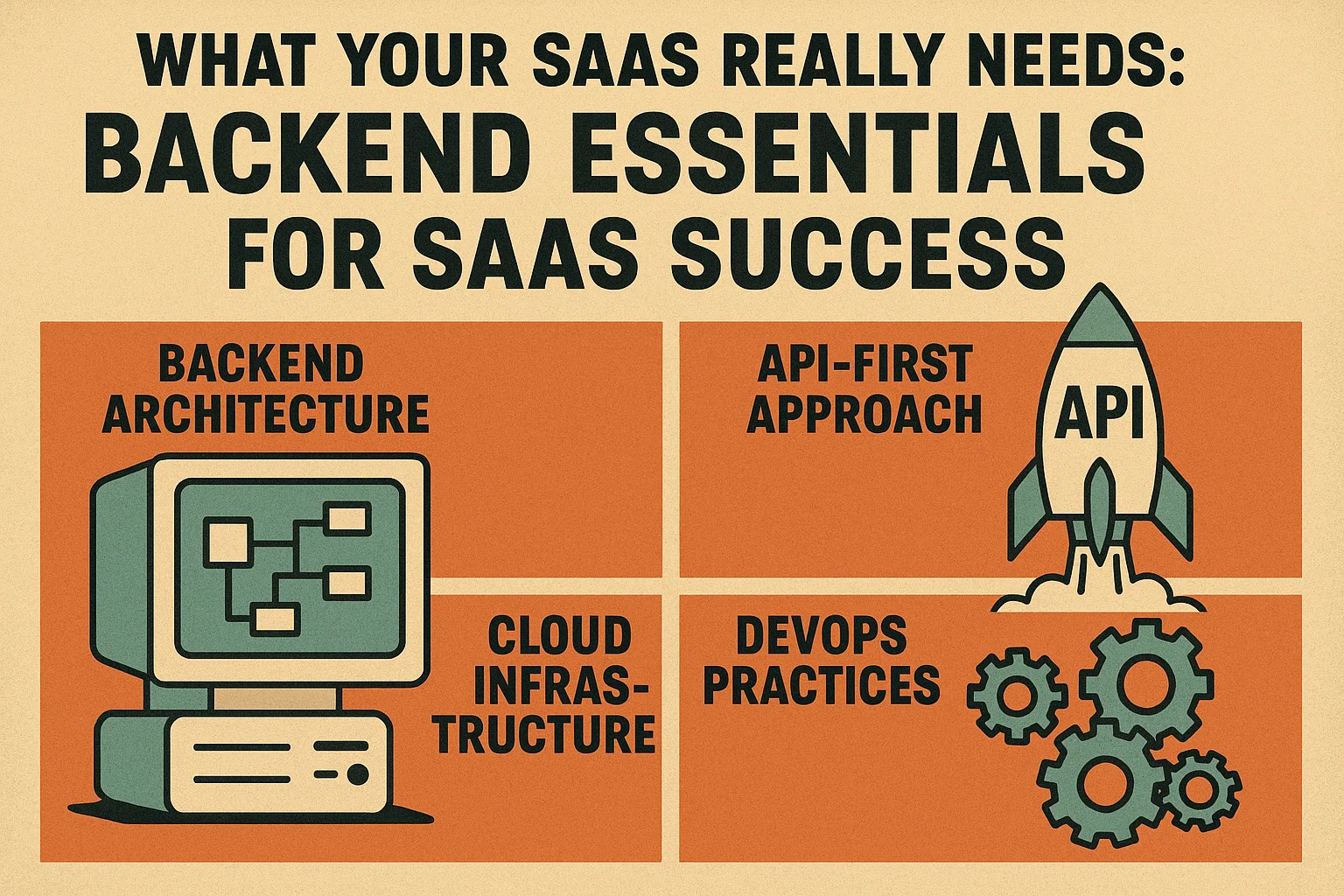
1. Database Architecture: The Brain of the Operation
Think of your database as the brain of your SaaS application. Messy, unstructured data will sink you faster than you can say "let's pivot to blockchain." You want a schema that is scalable, efficient, and able to bend as your product changes, because it will.
- SQL databases (like PostgreSQL) for structured, predictable data
- NoSQL databases (like MongoDB) for flexible, fast-moving, less tidy needs
Plan your database schema early. Retrofitting one later is exactly as painful as it sounds, and twice as expensive.
2. Cloud Infrastructure: Scaling Without the Server Room
The days of buying physical servers and praying are over, and good riddance. Modern backend development leans on cloud computing, AWS, Azure, or Google Cloud, for elasticity, cost control, and reach. You pay for what you use and scale when you need to, instead of guessing a year ahead.
Terms worth knowing so you can nod confidently in meetings:
- Auto-scaling, where capacity grows and shrinks with demand on its own
- Load balancing, which spreads traffic so no single server faints under pressure
- Serverless architecture, where you run code without babysitting the machine it runs on
3. API-First Development: The Secret to Staying Flexible
Your SaaS is not an island, no matter how special it feels. Integrations are the norm now, and an API-first approach means building your backend to talk to third-party services and mobile apps without a fight. An API (Application Programming Interface) is simply the contract that lets two systems exchange data cleanly.
Frameworks like Django, Express.js, and Laravel make this far less painful than it used to be.
APIs make your SaaS flexible. No APIs, no party, and definitely no enterprise customers.
4. Authentication and Authorization: Your SaaS Bouncer
Every serious app needs a velvet rope and someone checking the list. Authentication answers "who are you?" Authorization answers "and what exactly are you allowed to touch?" Get either wrong and you are one bad day away from a very awkward email to your users.
- OAuth2 and OpenID Connect for modern, standardized sign-in
- Multi-Factor Authentication (MFA), the extra step users grumble about and quietly benefit from
Users trust you with their data. Treat that trust like it is hard to earn and easy to lose, because it is.
5. Continuous Deployment and Monitoring: How to Actually Sleep
The real world is messy. Bugs ship. Traffic spikes at the worst possible hour. Servers fail in ways no one predicted. A healthy DevOps culture, yes, you genuinely need one, gives you automated deployment, real-time monitoring, and a fast way to catch fires before your users do.
Tools that earn their place:
- CI/CD pipelines (GitHub Actions, GitLab CI) that ship code without the drama
- Monitoring (Datadog, Prometheus) so problems page you, not your angriest customer
6. Caching and Queues: The Unsung Heroes
Two pieces of backend plumbing almost nobody mentions in pitch decks, yet they decide whether your SaaS feels fast or sluggish under load. Caching stores the results of expensive operations so your system does not recalculate the same answer a thousand times an hour. Queues let slow tasks, like sending emails or generating reports, happen in the background instead of making the user wait and watch.
- Caching tools like Redis turn a heavy database query into an instant response
- Message queues like RabbitMQ or SQS keep the user-facing app snappy while the heavy lifting happens offstage
If your app slows down exactly when it gets popular, the problem is usually missing caching, not a lack of servers.
Common Backend Mistakes That Quietly Kill SaaS Startups
Most backend disasters are not dramatic. They are small shortcuts that compound. The usual suspects in a struggling SaaS backend:
- No clear database plan, so every new feature bolts something onto a structure that was never meant to hold it
- Treating security as a launch-day checklist instead of a habit baked into every decision
- Ignoring monitoring until the first outage teaches you, expensively, why it mattered
- Hardcoding things that should be configurable, guaranteeing a painful rewrite the moment requirements shift
None of these feel urgent on day one. All of them send a bill on day three hundred.
When to Actually Worry About Scale
Here is the counterintuitive part. Plenty of startups over-engineer their backend for ten million users they do not have, while neglecting the basics that serve the hundred users they do. You do not need a globally distributed, multi-region architecture to launch. You need clean structure, sane security, and a backend that can grow when growth actually arrives.
The smart move in backend development is building a solid foundation that does not need a rewrite at your first real traffic spike, without gold-plating for a scale that may be years away. Plan for the next order of magnitude, not the next three. Premature scaling is just procrastination wearing an engineering hat.
How a Solid Backend Quietly Saves You Money
Cutting corners on backend development feels cheap right up until the bill arrives, and it always arrives. The greatest hits of skipped backend work:
- Bloated cloud bills from inefficient queries nobody bothered to optimize
- Data breaches that turn into lawyers, headlines, and lost customers
- Scalability walls that force an expensive rewrite right when momentum was finally building
Investing in a proper SaaS backend up front is not the glamorous choice. It is the one that lets you sleep, which, after a few launch weeks, you will value more than glamour.
Choosing Your Backend Stack Without Overthinking It
Founders lose entire weekends arguing about which language and framework to use, as if the wrong choice ends the company. It rarely does. A boring, well-understood stack that your team can actually maintain beats a trendy one that only one contractor understands. The best backend is the one that is still easy to work on a year from now.
A few sane defaults for a modern SaaS backend:
- Node.js with Express for fast, JavaScript-everywhere teams who want one language across the stack
- Laravel (PHP) for rapid, structured development with a huge ecosystem and gentle learning curve
- Python with Django when data, machine learning, or heavy business logic sit at the core
Any of these will carry you comfortably to thousands of paying users. The differentiator is not the logo on the framework, it is how carefully the backend development is done. Pick something proven, then spend your energy on architecture and clean code, which is where the real difference hides.
Why You Probably Should Not DIY the Backend
You can absolutely build the backend yourself, the same way you can cut your own hair. Sometimes it works out. Often it is a story you tell later with a wince. An experienced team spares you from the classics:
- Security loopholes you did not know existed until someone else did
- Scalability that crumbles the moment things go well
- Tech debt that compounds quietly until it owns your roadmap
Letting people who do this every day handle your backend development frees you to do the thing only you can do: grow the business. Learn more about our SaaS development services if you would rather build it right the first time.
Conclusion: The Backend Is Where the Magic Actually Happens
Do not fall for the comforting illusion that a pretty frontend alone can carry a SaaS product. The frontend gets the applause, but the backend is the gritty architect quietly holding everything up. Start smart, invest where it counts, and your future self, the one not debugging at 2am, will thank you.