Frontend, Backend, and DevOps in SaaS Development: Who Does What
If you are building a SaaS and the words frontend, backend, and DevOps keep appearing in job posts and pitches without ever being clearly defined, you are not alone. These three roles are the backbone of modern software development, and understanding what each does, and which you need first, is essential for any founder hiring or planning a custom SaaS build. Here is the plain-language breakdown.
Frontend, Backend, DevOps: Who Are These People, Really?
This is the holy trinity of modern software development, the three disciplines behind nearly every web product. They appear in every job post, tech pitch, and engineering debate, but the labels rarely come with a clear explanation. The short answer to "which do I need for my SaaS" is, eventually, all three, but they enter the picture at different times and do very different jobs. Let us break them down.
What Is Frontend Development?
The Interface People
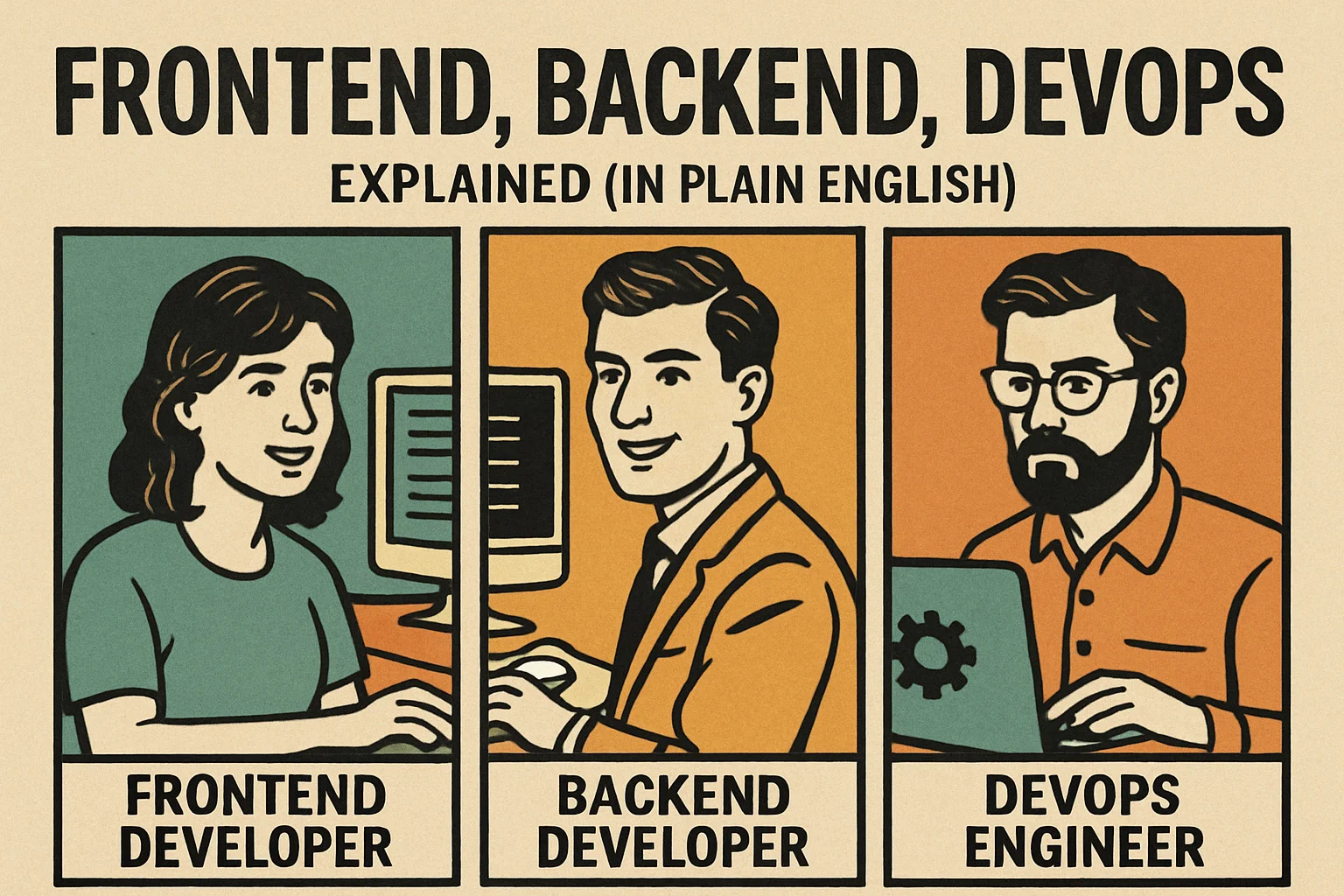
Frontend development is everything the user sees and interacts with: the layout, the buttons, the forms, the animations, the whole visible experience. Frontend developers turn designs into the working interface in the browser, using technologies like HTML, CSS, and JavaScript along with frameworks built on them. If the backend is the engine, the frontend is the dashboard and steering wheel, the part humans actually touch.
Why You Need Them
Your product could have flawless logic underneath and still fail if the interface is confusing, slow, or broken. Frontend developers make the product usable and pleasant, which directly affects whether people adopt it and stay. For a SaaS judged on user experience, strong frontend work is not optional, it is how the value of everything else actually reaches the user. The fundamentals here are well documented in resources like MDN.
What Is Backend Development?
The Logic People
Backend development is everything the user does not see: the server, the database, the business logic, authentication, and the APIs that connect it all. Backend developers build the engine that powers the product, handling data, security, and the rules that make the application actually do what it promises. When you click a button and something happens, the backend is what makes it happen correctly and securely.
Why You Need Them
The backend is where your product's real capability and reliability live. It determines whether the app scales, stays secure, handles data correctly, and survives traffic. A weak backend means slow performance, security holes, and a system that buckles as you grow, no matter how pretty the frontend is. For any SaaS doing real work, solid backend development is the foundation everything else depends on.
What Is DevOps?
The Infrastructure People
DevOps is the discipline of getting code from a developer's machine into production reliably, and keeping it running. It covers deployment pipelines, server infrastructure, monitoring, and automation, the systems that let a team ship updates safely and respond fast when something breaks. DevOps is the bridge between writing software and actually operating it at scale, explained well in guides like the AWS overview of DevOps.
Why You Need Them
Without DevOps, deploying becomes a manual, error-prone ritual, outages take longer to catch and fix, and scaling is a scramble. Good DevOps practices, automated deployment, real-time monitoring, and infrastructure that scales, are what let a SaaS ship frequently without breaking and stay reliable as it grows. It is the unglamorous discipline that turns working code into a dependable service.
So, Who Should You Hire First?
The honest answer depends on your stage, but most early SaaS products need backend and frontend capability first, to build a working product at all, with DevOps becoming critical as you start shipping regularly and scaling. In the earliest days, a versatile full-stack developer who can handle both frontend and backend is often the most efficient hire, with specialists and dedicated DevOps added as the product and team grow.
The mistake is hiring narrowly too early or ignoring DevOps until an outage forces the issue. Match the roles to your stage: build the product with frontend and backend skills, then invest in DevOps as deployment and reliability become daily concerns. An experienced partner can cover all three from the start, which is often simpler than assembling the team yourself.
Common Tech Stacks in Custom SaaS Development
These roles work with recognizable toolsets. On the frontend, frameworks like React, Vue, and Next.js dominate. On the backend, common choices include Node.js, Laravel, Python with Django, and similar frameworks. For DevOps, tools like Docker, Kubernetes, and cloud platforms such as AWS, plus CI/CD pipelines, handle deployment and infrastructure. You do not need to master these as a founder, but recognizing them helps you understand what your team is talking about and evaluate the choices they propose.
Mistakes Founders Make
A few errors recur. Hiring only a frontend developer and wondering why the product has no real functionality. Ignoring DevOps until a deploy goes wrong at the worst moment. Expecting one person to expertly cover all three roles indefinitely as the product grows. And underinvesting in the backend because its work is invisible, until scaling problems make it very visible. Understanding what each role actually does is the best defense against these mistakes, because you hire for real needs rather than guesses.
How These Roles Work Together on a Real Project
It helps to see how the three roles collaborate rather than just what each does alone. On a real build, the backend developer designs the data model and APIs, the frontend developer consumes those APIs to build the interface users touch, and DevOps sets up the pipeline that deploys both safely and keeps them running. They are constantly handing work back and forth, which is why communication between them matters as much as individual skill.
When these roles work well together, the result is a product that is functional, usable, and reliable all at once. When they work in silos, you get the classic problems: a beautiful frontend that the backend cannot support, a solid backend nobody can use, or great code that constantly breaks in production. The magic is not in any single role, it is in how well they coordinate, which is exactly why building software is a team sport rather than a collection of individual contributions.
Final Thoughts: It's a Team Sport
Frontend, backend, and DevOps are not competing options, they are complementary parts of one whole. The frontend makes the product usable, the backend makes it work, and DevOps makes it reliable and deployable. A great SaaS needs all three, brought in sensibly as the product grows. Understand what each does, hire for your actual stage, and remember that building software is a team sport where every position matters. Get the balance right and the product is fast, functional, and dependable, which is exactly what users and investors reward.