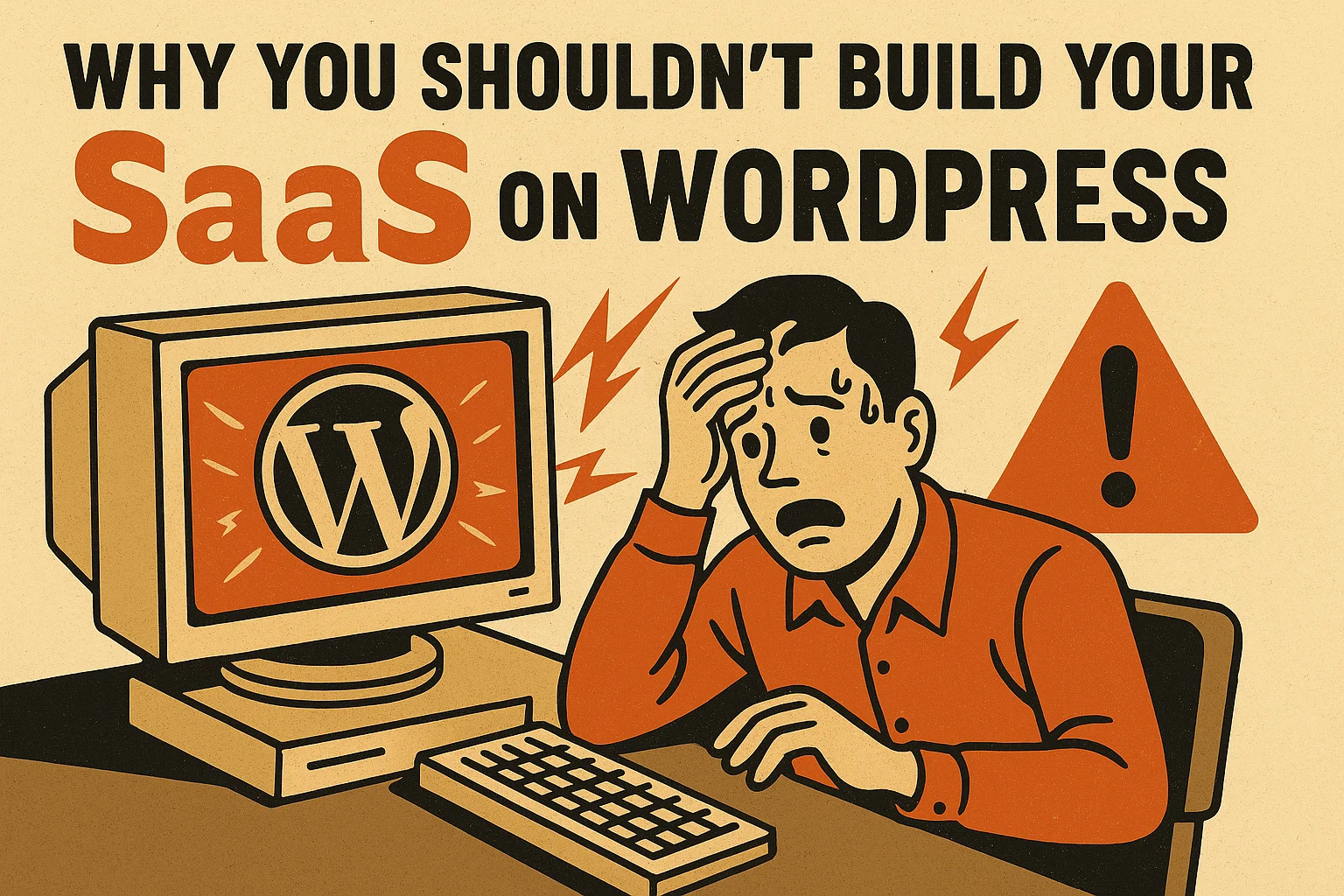
Why You Shouldn't Build Your SaaS on WordPress
WordPress powers over 40% of the web, which sounds like a strong argument for using it, until you notice that most of those sites are blogs, corporate pages, and the occasional recipe archive from 2011. Serious SaaS platforms? Far rarer, and for good reason. If you are even considering WordPress as the foundation for your SaaS, take a breath, then reconsider. Here is why experienced developers wince at that idea, explained without the jargon.
WordPress Was Never Meant for SaaS Logic
WordPress was built to publish content, and it is excellent at that. A SaaS product is a different animal entirely: it needs custom business logic, user roles and permissions, real-time data, complex workflows, and an application architecture that WordPress was simply never designed to provide. Yes, there are plugins, themes, and even WooCommerce, but bolting application behavior onto a content management system is fighting the tool's fundamental nature.
You can force it to work, the same way you can drive a screw with a hammer if you are determined enough. But you spend your time working around the platform instead of building your product, and every feature becomes a negotiation with a system that wants to be a blog. That friction compounds, and it never goes away.
Plugin Hell: Where SaaS Dreams Go to Die
The WordPress answer to any missing capability is a plugin, and for a SaaS that means stacking dozens of them to approximate features a real application framework provides natively. Each plugin is third-party code with its own update cycle, its own potential bugs, and its own security exposure. String enough of them together and you have a fragile tower where one update can break three other things.
This is plugin hell, and it is where many WordPress SaaS attempts quietly die. The maintenance burden grows faster than the product, developers spend their days fixing conflicts instead of shipping value, and the whole thing becomes a house of cards nobody fully understands. What looked like a shortcut becomes the slowest path of all.
Scaling? Good Luck
WordPress can be scaled, with enough caching, tuning, and expensive infrastructure, but it fights you every step. Its architecture and database design were built for content sites with predictable read patterns, not for the write-heavy, user-specific, real-time demands of a growing SaaS. The moment you have thousands of active users doing complex things, the cracks show, and the fixes get costly.
A purpose-built application framework scales naturally because it was designed for exactly this. WordPress scales reluctantly, with workarounds layered on workarounds, until you are spending more on keeping it upright than you would have spent building on the right foundation in the first place.
Security: An Open Invitation for Exploits
WordPress's popularity makes it a constant target, and its plugin ecosystem multiplies the risk. Every plugin is a potential entry point, and outdated or poorly maintained ones are among the most common ways sites get compromised. For a content blog that is manageable. For a SaaS handling user data, payments, and sensitive information, it is a serious liability that demands constant vigilance.
A custom application gives you control over your security posture, a smaller attack surface, and no dependence on the security practices of dozens of third-party plugin authors. When you are responsible for customer data, that control is not a luxury, it is a requirement.
Developer Experience (a.k.a. Sanity)
Ask developers who have built application logic in WordPress how they feel about it, and brace for the sighs. Working against the grain of a content platform, wrestling with its conventions, and maintaining a plugin tangle is genuinely demoralizing. Good developers want to build on tools designed for the job, and forcing them into WordPress for a SaaS is a fast way to frustrate your best people.
This matters more than it sounds, because developer experience translates directly into velocity and retention. A team that enjoys its stack ships faster and stays longer. A team fighting its foundation burns out and moves on, taking institutional knowledge with them.
What You Should Use Instead
For a real SaaS, build on a framework designed for applications. Laravel offers structure, built-in security, and excellent tooling for PHP teams. Node.js with Express or NestJS suits JavaScript-everywhere teams and real-time needs. These frameworks were built for custom logic, user management, scaling, and security, the exact things a SaaS demands and WordPress resists. Our development team builds SaaS products on these foundations precisely because they hold up where WordPress buckles.
WordPress still has a place in your stack, for your marketing site and blog, where it genuinely shines. The mistake is using it for the product itself. Use the right tool for each job, and let WordPress do what it is good at while your application runs on a proper foundation.
The Migration Trap: When WordPress SaaS Hits the Wall
The painful pattern plays out the same way again and again. A founder builds their SaaS on WordPress because it is familiar and fast, it works at first, and then growth arrives. The plugin tower starts cracking, performance degrades, security scares mount, and developers spend more time firefighting than building. Eventually the realization lands: the platform itself is the problem, and the only real fix is migrating to a proper foundation.
That migration is expensive, risky, and stressful, precisely because it happens under pressure with real users on the line. Everything has to be rebuilt on an architecture that should have been chosen at the start, while keeping the existing product running. The teams who avoid this trap are the ones who chose the right foundation early, when it was cheap to do so. The convenience of starting on WordPress is real, but it is borrowed against a future bill that comes due exactly when you can least afford it.
Final Thoughts From a Web Dev Who's Seen Too Much
The temptation to build a SaaS on WordPress is understandable, it feels familiar, cheap, and fast at the start. But that early convenience turns into a long-term tax of plugin maintenance, scaling pain, security risk, and developer frustration. The shortcut becomes the slowest, most expensive road. Build your SaaS on a real application framework, keep WordPress for your content, and you save yourself the rebuild that almost every WordPress SaaS eventually faces. If you are weighing the foundation for your product, it is worth a conversation before you commit, so feel free to reach out. We have helped teams across many industries build SaaS the right way from the start.