CMS Development Services: What They Are and Why Your Startup Needs Them
Most startups treat their content management system as an afterthought, something you install, fill with content, and forget. Then it becomes the bottleneck that slows every update, breaks under traffic, and quietly costs you more than a proper build ever would. CMS development is the work of building that system around your actual business instead of forcing your business into someone else's template. Here is what that means and why it matters.
What Is CMS Development (and Why Your Startup Should Care)
Let us clear the jargon first. CMS stands for Content Management System, the software that lets you create, manage, and modify content on your website without touching code, at least ideally. But here is the catch: not all CMS platforms are created equal, and not all setups serve your business well.
CMS development is the process of building, customizing, or optimizing a content management system to match your startup's actual business logic, not someone else's generic assumptions. It is the difference between bending your workflow to fit a template and having a system shaped around how your team really works. For a growing startup, that difference compounds into either smooth operation or constant friction.
The Problem With DIY Plugin Culture
Cheap Today, Expensive Tomorrow
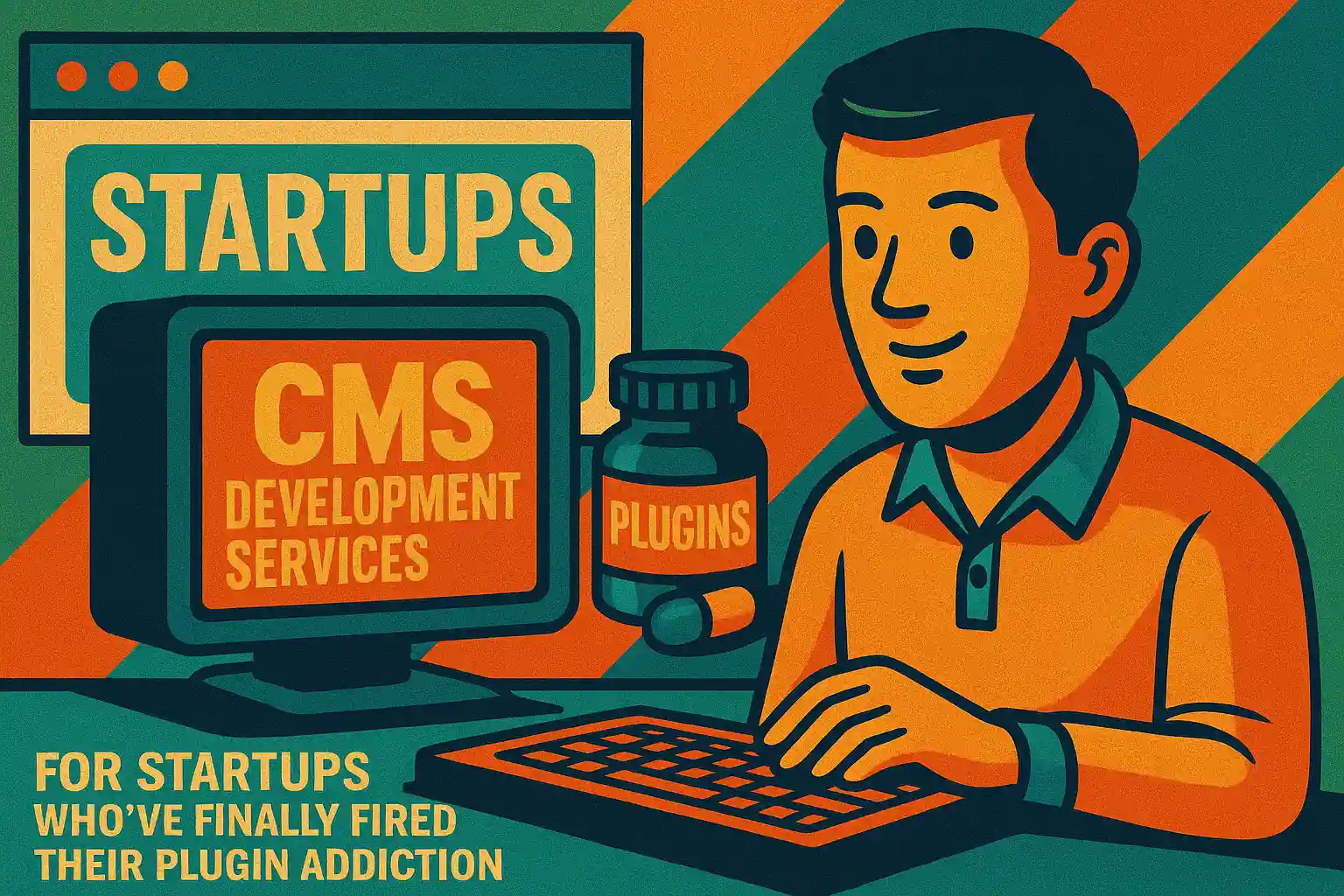
The DIY approach, stacking plugins on a generic platform to approximate what you need, looks cheap and fast at the start. The bill arrives later. Every plugin is a dependency that needs updating, a potential security hole, and another thing that can break when something else changes. What saved money on day one becomes a maintenance tax that grows every month, until you are paying far more in time and risk than a proper build would have cost.
Bad for Performance, Worse for UX
Plugin-heavy sites are slow sites. Each plugin loads its own code, and a tower of them drags down page speed, which hurts both user experience and search rankings. The user feels the lag, Google notices the slowness, and your team feels the fragility every time an update breaks something. The DIY shortcut quietly degrades the very things that matter most.
What Proper CMS Development Actually Looks Like
Built Around Your Workflow
Real CMS development starts with how your team actually creates and publishes content, then builds a structure that fits it. Instead of forcing your editors to work around a template's limitations, the system reflects your real content types, your real workflow, and your real goals. The result is a CMS people find easy to use because it was built for them, not for everyone in general.
Flexible, Not Fragile
A well-built CMS bends without breaking. When you need a new content type, a new section, or a new integration, it accommodates the change cleanly rather than requiring a fragile workaround or a stack of new plugins. This flexibility is what lets the system grow with your business instead of becoming the thing you have to replace once you outgrow it.
Tech That Can Grow With You
Proper CMS development builds on a foundation that scales. As your traffic, content, and team grow, the system handles it without the dramatic slowdowns and rebuilds that plague plugin-heavy setups. You invest once in something that lasts, rather than repeatedly patching something that was never built for where you are heading.
Why Founders Keep Coming Back (After Their First Dev Ghosts Them)
A common story: a founder hires the cheapest developer, gets a plugin-stacked site that works briefly, then watches it degrade while the developer becomes unreachable. Eventually they come looking for a team that does CMS development properly, having learned the expensive way that cheap and proper are not the same thing.
The founders who return value the things the cheap option lacked: clean code they can build on, a system their team actually understands, performance that holds, and a partner who does not vanish after launch. Once you have experienced the difference, the false economy of the DIY route becomes obvious, which is exactly why proper CMS development earns repeat trust.
Our CMS Development Process (Without the Buzzwords)
Good CMS development is not mysterious. It starts with understanding your business and how your team works with content. From there it moves to designing a content structure that fits, building it on a foundation that scales, and testing that it actually serves your workflow. Then comes launch, and crucially, support afterward, because a CMS is a living system, not a one-time delivery.
The whole point is to remove guesswork and fragility. You end up with a system you understand, code your future developers can maintain, and a structure that grows with you, all without the buzzword theater that often surrounds agency work. Substance over jargon is the goal.
Who Is This For?
Proper CMS development makes sense for startups and growing businesses that have outgrown, or want to avoid, the limitations of generic platforms and plugin stacks. If your content needs are specific, your team publishes regularly, you care about performance, or you are planning to scale, a custom or properly optimized CMS pays for itself. If you only need a simple brochure site that will never change, a basic template is genuinely fine, and honesty about that is part of good advice. You can see how we approach this work on our main site.
The Hidden Cost of Getting CMS Development Wrong
The true cost of a poorly built CMS rarely appears on an invoice. It shows up as the hours your team loses fighting the system, the publishing delays when a simple change needs a developer, the security scares from outdated plugins, and the slow pages that quietly cost you visitors and rankings. None of these are line items, which is exactly why they are so easy to underestimate until they add up to something serious.
Then there is the ultimate cost: the rebuild. A CMS that cannot grow with you eventually has to be replaced, and migrating content, preserving SEO, and recreating functionality is expensive and risky work. Proper CMS development up front is how you avoid paying that bill, building once on a foundation that lasts instead of twice on one that does not.
Final Word: Plugins Are Not a Strategy
Stacking plugins is a way to avoid making decisions, not a way to build a serious foundation. It feels like progress because something works today, but it quietly accumulates the cost, fragility, and performance problems that eventually force a rebuild. Proper CMS development is the alternative: a system built around your business, flexible enough to grow, and solid enough to trust. It costs more thought up front and far less pain later, which is exactly the trade a growing startup should want to make.